
Beyond Decoration: The Power of Black-and-White Architectural Photography in Modern Interiors
How architectural photography can bring structure, emotion, and a distinctive sense of place to contemporary spaces.
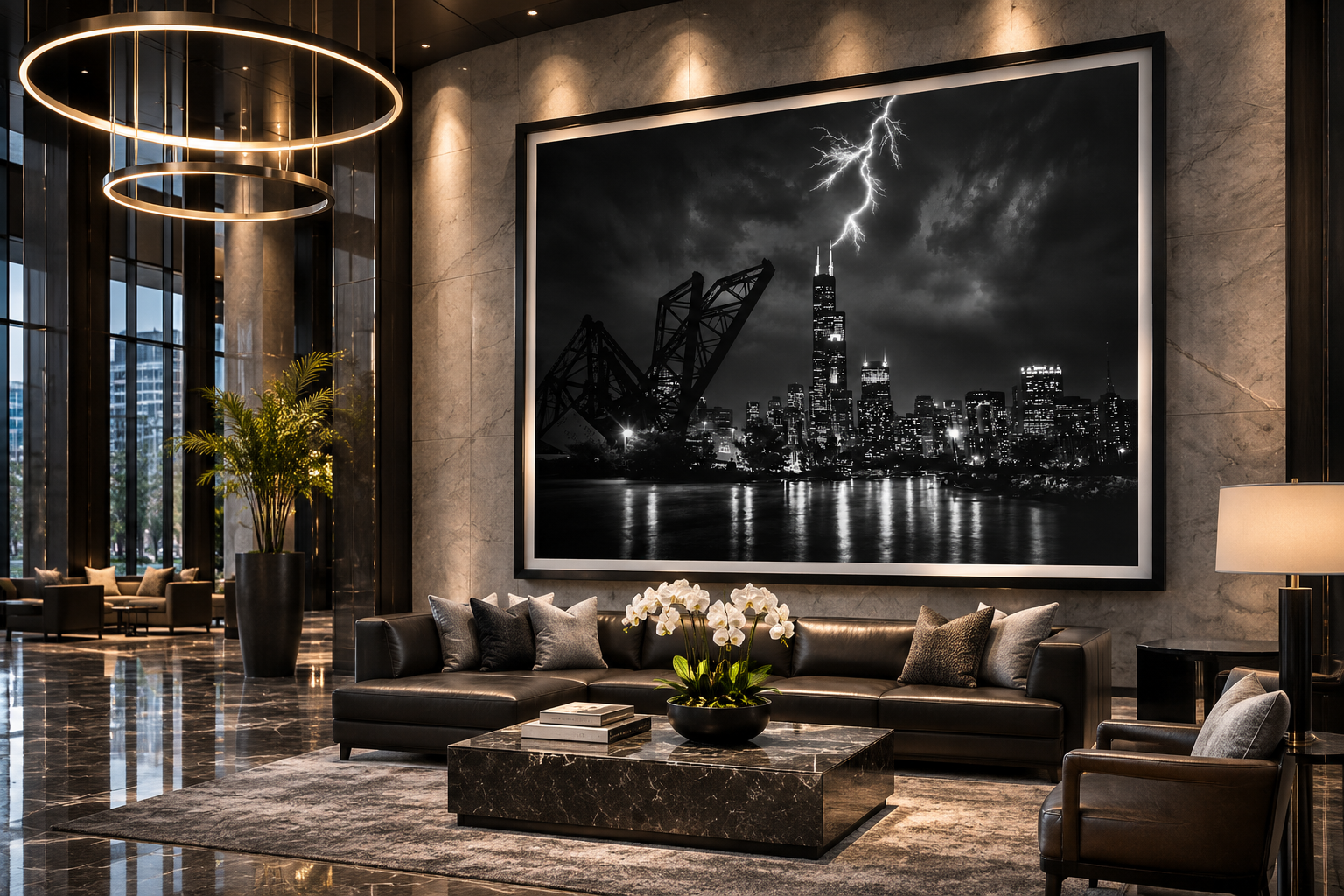
Interior designers spend considerable time considering color, texture, proportion, lighting, and spatial relationships. Yet one of the most powerful elements in a finished room is sometimes treated as an afterthought: the artwork.
Particularly in contemporary interiors, black-and-white architectural photography offers something that many other art forms do not. It can reinforce the architectural language of a room while introducing a new visual perspective.
The result can be more than decoration. The right photograph can become an integral part of how a space is experienced.
1. Architecture in Conversation with Architecture
One of the compelling qualities of architectural photography is its ability to establish a visual relationship with the space in which it hangs.
A photograph emphasizing strong vertical lines can complement a room with tall windows and high ceilings. Sweeping curves can soften a rectilinear environment. Repeating geometric patterns can introduce rhythm into an otherwise restrained interior.
The objective isn't necessarily to match the architecture depicted in the photograph with the architecture of the room. Sometimes the most interesting results come from contrast.
A dramatic photograph of a curved modern structure, for example, can create a compelling counterpoint to a room dominated by straight lines and angular furniture.
The artwork becomes part of the architectural conversation.
2. The Freedom of Black and White
Color photography introduces another palette into a room. That can be desirable, but it can also compete with carefully selected furnishings, fabrics, and finishes.
Black-and-white photography operates differently.
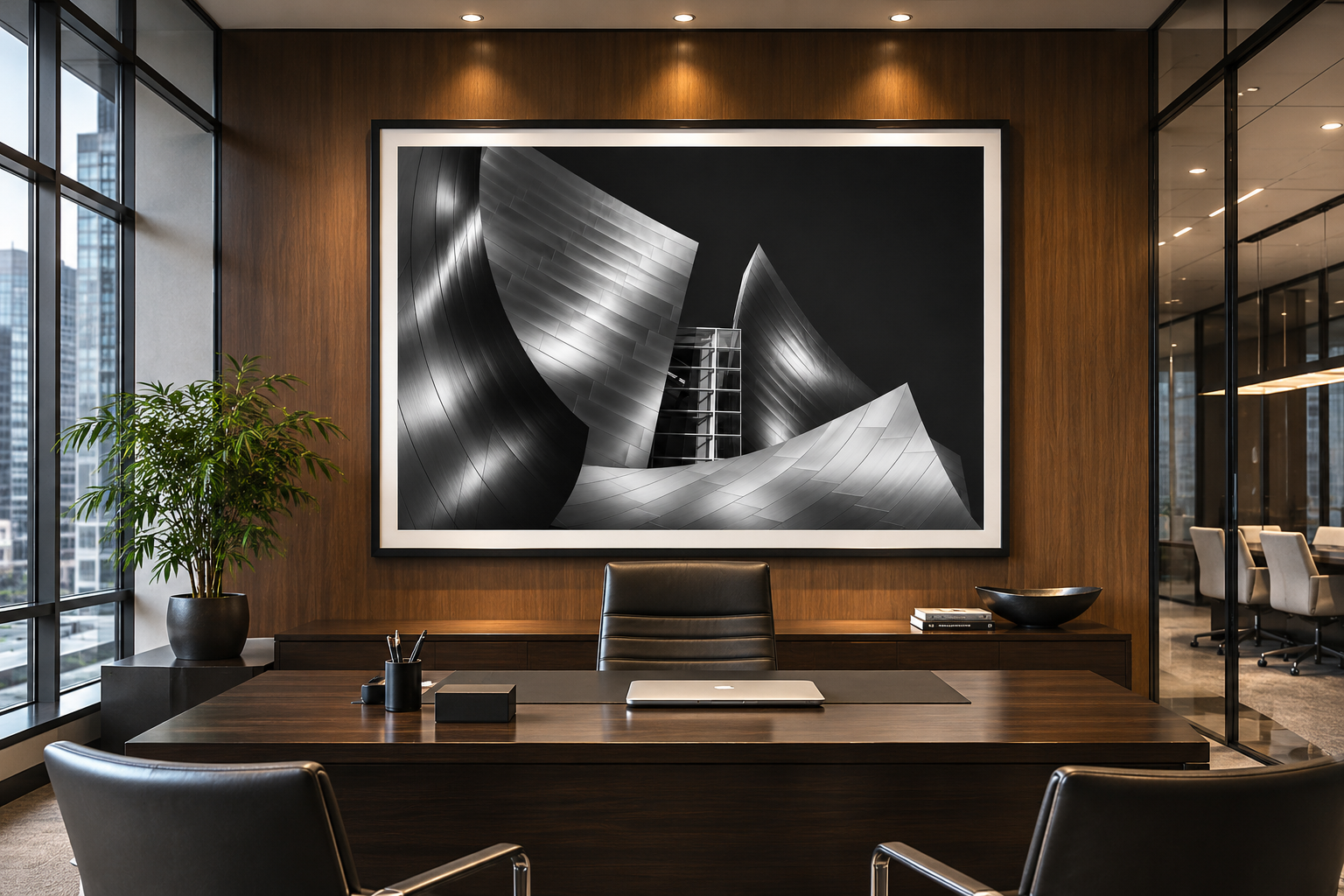
By removing color, it draws attention to form, light, shadow, texture, and composition. It can complement a wide range of interior palettes without requiring the designer to coordinate the colors within the image.
This versatility makes monochrome architectural photography particularly effective in contemporary interiors where materials such as wood, stone, glass, steel, and textured fabrics play important roles.
But black and white should not be confused with visually neutral.
A high-contrast architectural image can become the most commanding element in a room. A photograph with delicate tonal transitions can create a quieter, more contemplative atmosphere.
The designer's choice depends on the emotional character the space is intended to convey.
3. Creating a Focal Point Without Visual Clutter
Contemporary interiors often rely on restraint. Every object competes for attention, and too many competing elements can diminish the impact of the whole.
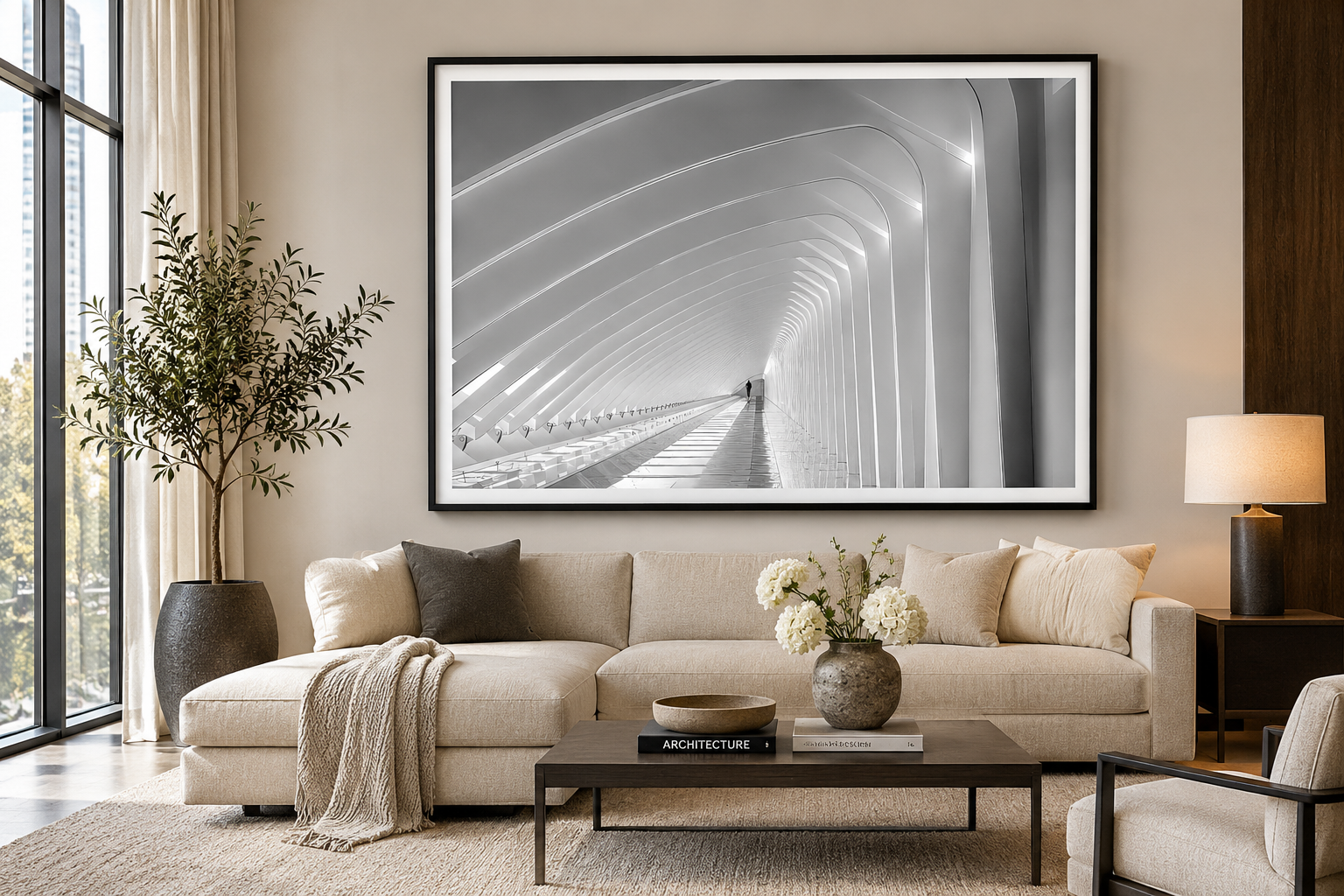
Architectural photography can create a strong focal point without introducing unnecessary visual complexity.
A single large-scale image above a sofa, behind a reception desk, or at the end of a corridor can establish visual hierarchy.
Scale matters. A photograph that looks compelling at 16 inches wide may have an entirely different impact at 48 inches.
Equally important is the relationship between the photograph's composition and the surrounding space. Negative space within an image can give a room breathing room, while a tightly composed architectural abstraction can create energy and movement.
The question isn't simply whether the photograph fits the wall. It's whether it contributes to the overall balance of the room.
4. Giving Commercial Spaces a Distinctive Identity
In hospitality and commercial design, artwork can play a role beyond aesthetics.
A boutique hotel, restaurant, or corporate environment is often designed to communicate a particular personality. Artwork can reinforce that identity through subject matter, mood, and visual style.
Architectural photography offers several possibilities.
A dramatic urban image may suggest sophistication and energy. A minimalist study of architectural form may communicate precision and refinement. An unusual perspective on a familiar building may encourage curiosity and discovery.
Rather than selecting artwork simply because it coordinates with the furnishings, designers can consider what the imagery contributes to the story of the environment.
This is particularly relevant in spaces where creating a memorable experience is part of the design objective.
5. The Importance of Tonal Quality
Not all black-and-white photographs produce the same visual effect.
Some depend on stark contrasts and deep blacks. Others use subtle gradations of gray to create a luminous, almost silvery quality.
These distinctions become especially important when photographs are displayed at large scale.
A richly detailed monochrome image can interact beautifully with natural materials and carefully controlled lighting. Conversely, an image with excessive contrast may overwhelm a quiet interior.
Print surface, framing, glazing, and lighting also influence the final presentation. Matte surfaces can minimize distracting reflections, while certain photographic papers offer greater tonal depth and richness.
The artwork should be evaluated not simply as an image on a screen, but as a physical element within the intended environment.
6. Choosing Art for the Experience, Not Just the Wall
Perhaps the most useful question a designer can ask when selecting artwork is not, "Does this look good here?"
It's, "What do I want someone to feel when they enter this space?"
Calm? Energy? Curiosity? Sophistication? Wonder?
Black-and-white architectural photography can evoke all of these responses, depending on its subject, composition, tonal treatment, and placement.
The strongest selections are those that contribute to the experience of the room rather than simply completing its decoration.
A Final Thought
Great interior design is about relationships: between form and function, light and shadow, materials and space.
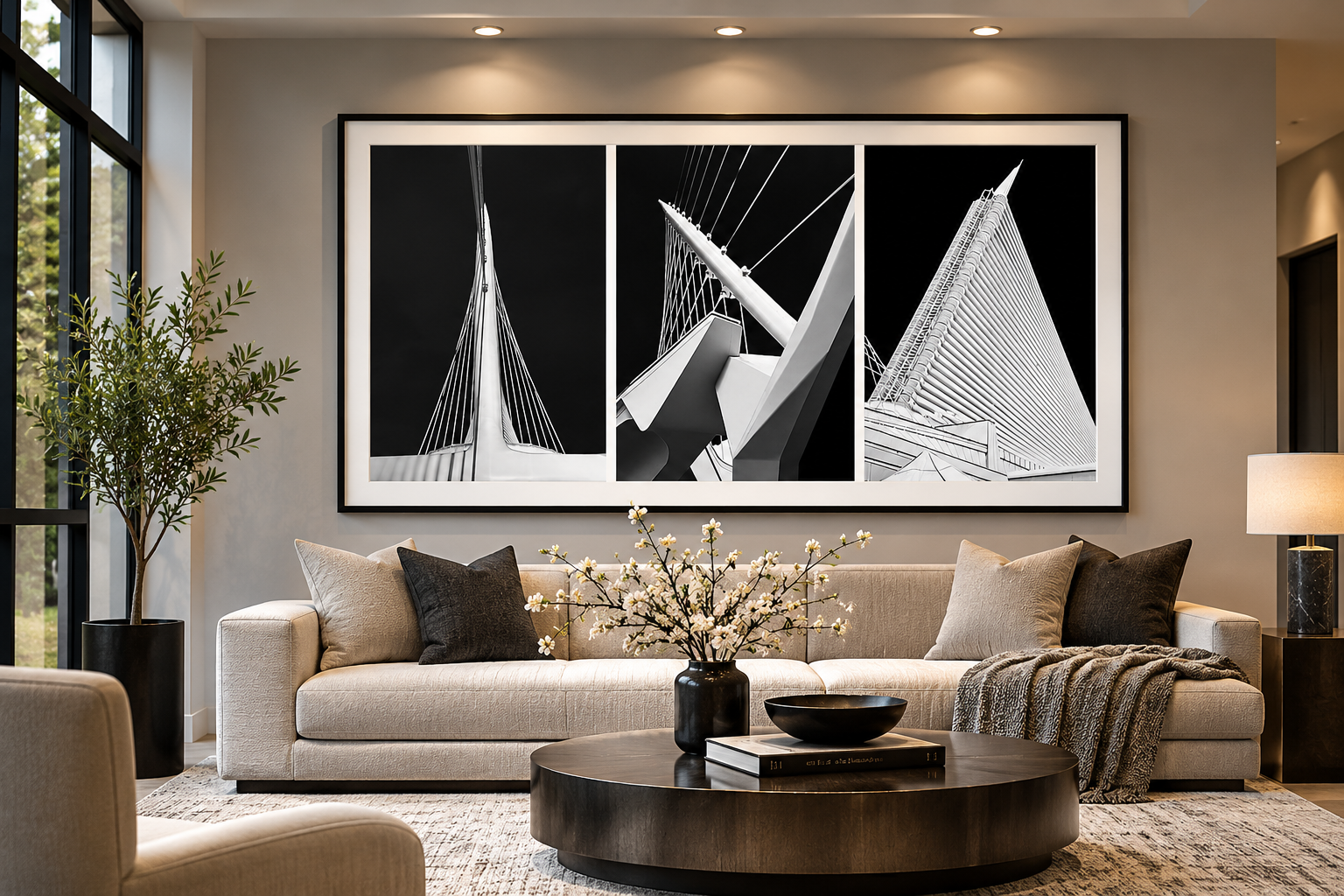
Architectural photography introduces another relationship—between the architecture we inhabit and the architecture we observe.
When thoughtfully selected and placed, it doesn't merely occupy a wall.
It becomes part of the space's identity.
About the Author
Jim Signorelli is a fine-art photographer, digital artist, and author of StoryBranding. His photographic work explores architecture, nature, and abstraction, with particular emphasis on the emotional and visual qualities of black-and-white imagery. He also teaches Photoshop and creative photographic editing at the Evanston Art Center.